Concepts Summary
A beginner's overview of the basic concepts in Madhyasth Darshan. Click to navigate:
Knowledge is Happiness
Everything that exists is called 'Existence'. Today, we assume things are in random arrangement, that the Universe is in chaos. However, Existence is co-existence itself, in harmony and orderliness.
Animals, plants, stones, and minerals are in 'self-organization' and participate in larger orderliness. The current human situation is as follows:
Human Understanding and Harmony
Human-Nature Relationship:
Due to lack of self-organization, humans struggle to fulfill relationships with animals, plants, and materials, manifesting as ecological problems.
- This manifests as the ecological problem.
Human-Human Relationship:
Humans struggle to fulfill relationships with each other, leading to economic, social, relational, criminal, and war-related issues.
- This manifests as economic, social, and relational problems, criminal mentality, war, and exploitation.
Within:
Humans face internal contradictions, lack of clarity, and self-doubt, resulting in unhappiness and indefinite behavior.
The reason for the above issues:
- The 'Self'
- Existence (all that exists)
- Man's purpose and relationship with units in existence (Humane Conduct)
Humans desire harmony and happiness, fulfilled by knowledge (right understanding) and material goods.
Knowledge of self, existence, and humane conduct resolves humans, fulfilling existential, intellectual, ethical, and emotional needs, resulting in happiness.
Knowledge provides the basis for imagination, desires, and conclusions about physical reality, forming the foundation for living.
Knowledge is:
- Knowledge of all that exists. [अस्तित्व दर्शन ज्ञान]
- Knowledge of the conscious self: [जीवन ज्ञान]
- Knowledge of perfect-Humane Conduct: (मानवीयता पूर्ण आचरण ज्ञान)
This is to inform you that:
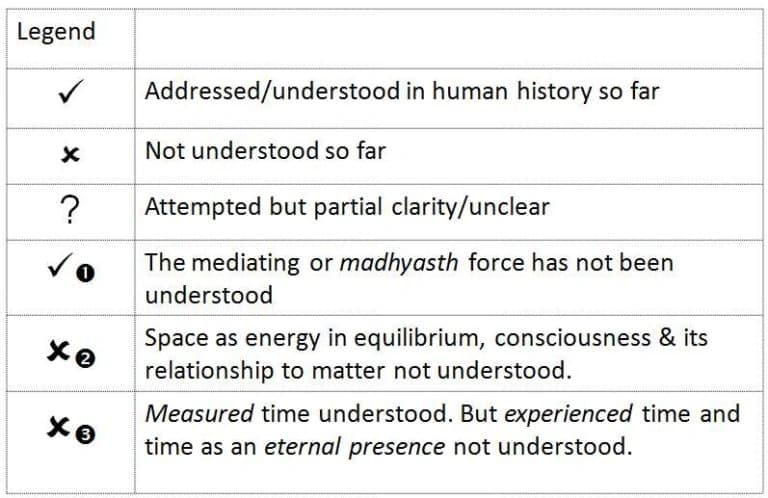
"Co-existence" (reality) is now study-able. Existence is understood as a coexistence of physiochemical, conscious, and pervasive entities (space/void).
The human is a combination of a conscious unit and a physiochemical body. The nature of consciousness and human purpose is now clear, including universal human conduct, values, and religion.
Existence (reality) is Coexistence
Existence includes material things, space, and conscious units (jeevan). Coexistence means material and conscious units in pervasive space, with definite progression.
1. Existence is Coexistence:
Existence includes physical, chemical, and conscious entities in pervasive space.
2. There is evolution in Existence:
Evolution occurs naturally, from atoms to molecules, plants, and animals, driven by a mediating force in the atom's nucleus.
3. There is 'development' in Existence:
Atoms achieve constitutional-completion, becoming weightless, indestructible conscious units (jeevan) with the will to live, as seen in animals and humans.
4. There is Awakening Progression in Existence:
Humans, with evolved bodies, seek happiness through knowledge, distinguishing them from animals with the ability to think and imagine.
Reasons for the current human situation:
Human perception is limited to form and properties, insufficient for understanding reality's purpose and nature, leading to complex problems.
5. There is 'Awakening' in Existence: the solution:
Accessing all faculties of the conscious self allows understanding of all four dimensions of reality (form, properties, innate-nature, beingness), leading to holistic knowledge and happiness.
Kinds of humans
Humans are categorized into two planes and five classes based on understanding and living:
Plane A: Animal consciousness plane (partial understanding):
- 1) Servile human 2) Fiendish human
Plane B: Human-consciousness plane (complete understanding):
- 3) Humane, 4) Godly, and 5) Divine humans
Human behavior can be explained based on these planes.
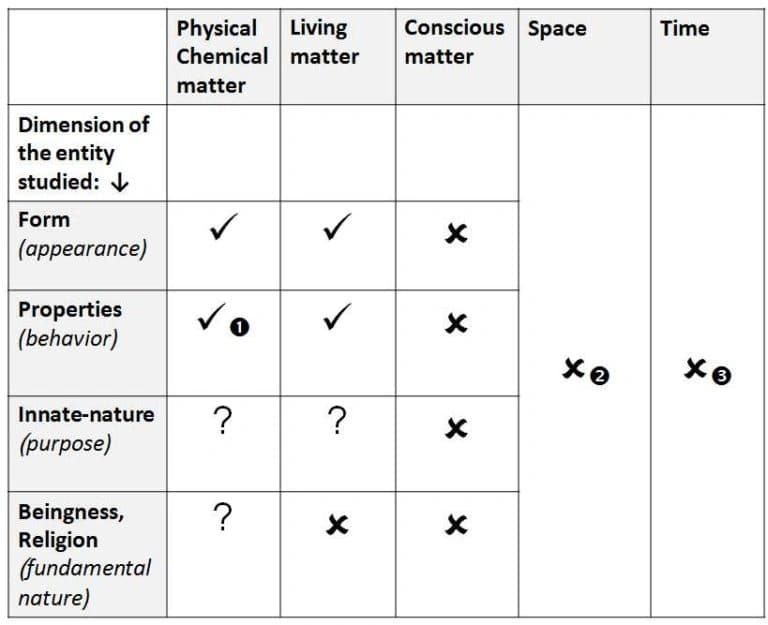
Man is part of reality, which is coexistence, not chaos. Every entity (matter, plants, animals, humans) has four dimensions: appearance, properties, innate-nature, and beingness/religion. (रूप, गुण, स्वभाव, धर्म).
Knowledge awakens humans, enabling life in human consciousness with happiness and humane conduct.
The table below shows dimensions of reality explored by spirituality/religion and materialism/science, clarified by Madhyasth Darshan:
Summary
Fundamental findings:
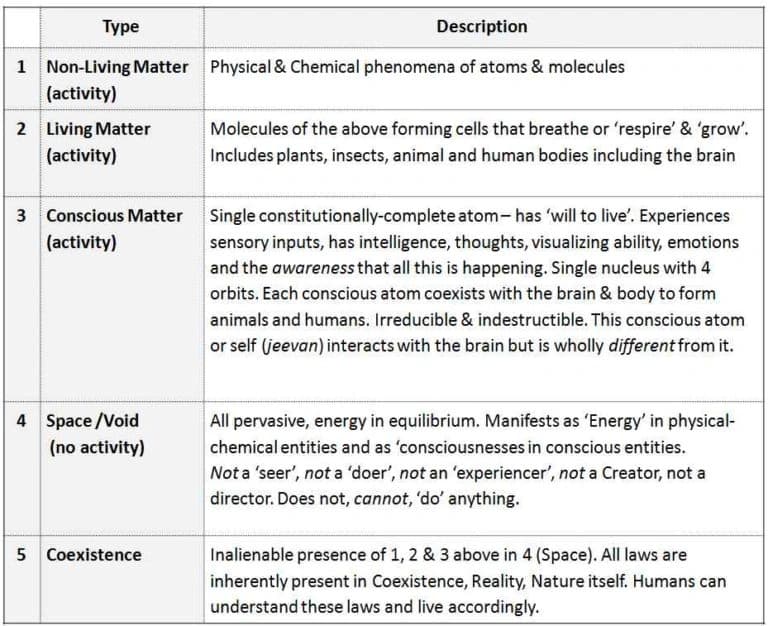
Space (all-pervasive entity) is omnipresent, manifesting as energy in insentient matter and consciousness in sentient matter. It is inactive, eternal, and not the creator or controller.
Physical and conscious matter exists as units with four dimensions: form, properties, innate-nature, and religion. Full understanding requires employing all 10 faculties of the conscious self.
Harmony in Living
Knowledge leads to fulfillment, manifesting as harmony at multiple levels:
1. Harmony in Ourselves
Knowledge fulfills us spiritually, intellectually, and emotionally, resolving all questions and establishing intellectual resolution.
2. Harmony in Human Family
We recognize and fulfill family relationships (parent, child, sibling, friend, teacher) with emotions like trust, respect, and love, achieving material prosperity.
3. Harmony in Society
Living harmoniously in families extends to society, recognizing and fulfilling social responsibilities through universal social laws.
4. Harmony with Nature
Nature is inherently harmonious. Understanding coexistence allows humans to accept natural laws and live harmoniously with nature.
One Human Race, One Human Religion
Knowledge reveals that all humans seek happiness through understanding coexistence.
Despite apparent differences, human anatomy is fundamentally the same, unlike varied animal species.
Human Religion is One = Happiness
Religion means being bound by the need for happiness and knowledge. Our Religion is Happiness.
Human Race is One
Based on similar anatomy, differences in class, caste, or language are illusory. Knowledge frees us from such delusions.
Undivided Human Society, Universal Order
Current societal fragmentation and governance systems rely on force, causing conflict. Discrimination and faulty beliefs fuel terrorism.
Knowledge of coexistence fosters equality and harmonious relationships, leading to an Undivided Human Society.
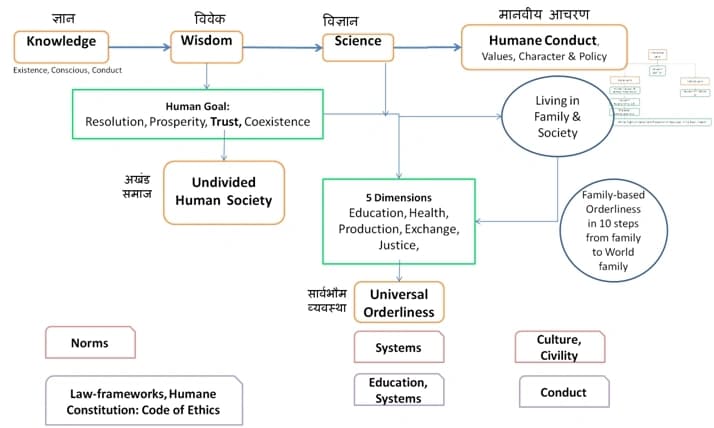
Five Dimensional Human Program
Human organization sustains endeavors for an awakened society, achieving happiness, peace, satisfaction, and bliss.
Programs include:
- Ensuring knowledge in the conscious self (Resolution)
- Meeting bodily requirements (Prosperity)
These fulfill the Universal Human Goal:
- Intellectual Resolution in every human
- Material Prosperity in every family
- Fearlessness in society (Undivided Society)
- Coexistence with nature (Universal Order)
Five committees in each village (100 families, 10 members each) address:
- Education & right values (sanskar Committee)
- Health & Discipline (Committee)
- Production & Work (Committee)
- Exchange & Storage (Committee)
- Justice & Security (Committee)
10-staged Family-based World Organization
These dimensions scale from a single family to the world in 10 stages, with representatives forming village councils.
Objective of Jeevan Vidya
- Qualitative improvement from animal-consciousness to human-consciousness
- Evidence of humans living with humane conduct
- Undivided Human Society and balance in nature for universal orderliness
Scope of Jeevan Vidya
Knowledge (gyaan)
- Understand the human being (conscious and physical aspects)
- Understand existence and purpose of all entities
- Understand true-nature or definite humane conduct
Wisdom (viveka)
- Identification of intellectual, social, and natural laws
- Identification of the Universal Human Goal
Science (vigyaan)
- Knowledge of activity, time, and decision
- Physical, Behavioral, and Spiritual Science
– shriram n | student | january 2012, updated january 2017
Go to top of the page