World Organization
The Concept of Village based Organization – by A Nagraj
“The basis for an Undivided Society is Village Organization”
– From the Original Hindi (परिवार मूलक ग्राम स्वराज्य व्यवस्था) by A Nagraj | English version by Shriram | Student | Jan 2017
The Family is the fundamental unit of the Village Organization. The family itself is a complete humane organization. Swarajya or self-rule means having the ease of access to Justice, Production & Exchange. The meaning of freedom or swatantrata is every human being self-organized and expressing, conveying and propagating the same. This takes place by knowing and assuming the Truth in the form of Existence, i.e. recognizing & fulfilling the mutually occurring relationships & values in Existence.
“Every Human in Existence” is in organization with humanness and participates in the social organization. The obvious form of this is freedom in the form of self-organization and swarajaya or self-rule in the form of participation in the entire (larger) order. The participation of organization with the entirety is only possible with more than one person. Which is why the combined form of more than one person itself is nothing but family. It is only with perfect human conduct & behavior along with the availability of intellectual resolution and material prosperity in such a family that village self-rule or organization itself becomes easily possible which becomes the basis for an undivided society.
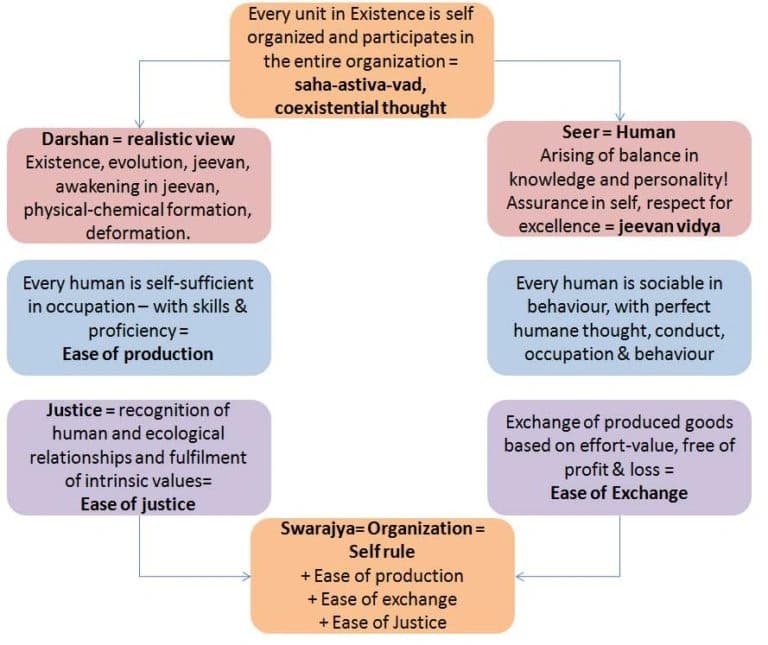
Availability of justice-security in the family and in humanity means the recognition of human and ecological relationships and the fulfillment of values intrinsic in them. The form of self-sufficiency in human tradition is freedom (self-organization) in state and self-rule or organization in expression.
Ease of access to means of production-work means making every member of the family independent in occupation by the time they become an adult, so that every adult in the family can get together and produce more than the material needs of the family. Production within the means of humanness means the production of ordinary expectations (food, clothing, shelter) and extraordinary expectations (radio, transport & television) by putting in physical efforts on the natural grandeur without causing it any harm – in a complementary manner. Material prosperity in the family does need more than this, nor is material prosperity possible in less than this.
Ease of access to cooperative exchange-storage systems means the exchange of goods produced by the family with other families, on the basis of effort-value in a manner free of profit & loss (profit is defined as taking more and giving less in return), so every family can experience material prosperity. Profit centric business setups do not have any room in this system. Complete exchange systems means the exchange of investments of efforts of one family with other families on the basis of the effort-values (of the goods). The village shall have a storage facility, by means of which the excess production in every family shall be exchanged in external markets and the required goods from such external markets or villages shall be made available to the village inhabitants. This system shall be connected to the county, block, district, state and entire nation in a staged manner.
It is only after village self-rule or organization is established and easily available, that it becomes possible for every human to participate in the entire existential organization and himself be occupied with humane organization. This itself is the witness of jeevans awakening for which human tradition has been desiring & waiting since time immemorial. Jeevans awakening itself propounds the meaning and usefulness of universal order in humans because evidence and resolution itself are expressions of universality in human tradition.
Becoming proficient in universal sociability is wisdom, its conduct is authority and its protection and enrichment in continuity is sovereignty.
This itself is the aphorism or sutra for humane constitution. The final aim of village organization is the establishment of undivided sociability by which every human in society shall have access to intellectual resolution, material prosperity and ‘coexistence’ in a universal manner.
Thus, the primary aim of this program is to realize and make others realize, the family centric village organization. Every member of every family in the village shall live with perfect humane conduct. Every human shall recognize and fulfill human & ecological relationships and their intrinsic values. They will obtain material prosperity – in others words, greater production than that is required. They shall express, convey & propagate intellectual resolution. To enable such capabilities itself is Village Organization.
The basis of the ‘Village Organization Plan’ is the development of a production based utility-based perspective in the place of a job & business oriented mentality. This is our conception and commitment.
10-Staged Family-Based World Organization
Plan for Organization Councils
1st Level: The Family Council
Every family in the village shall be in the form of ten (10) members. Should there be less than 10 members in a family, they shall join together with neighbouring families to form a family council. Every member — be it children or old people — shall be members in the council. The members shall elect one head to represent them in the neighbourhood council, someone well-versed with self-understanding (jeevan vidya) and material understanding.
2nd Level: Neighbourhood Council
Heads of 10 families form a neighbourhood or family-group council. One member from 10 such councils shall be elected to the village council.
3rd Level: Village Council
10 elected members from 10 neighbourhood councils (100 families) form the village council. One member becomes the chief. The ratios may be adjusted based on actual numbers.
4th–10th Levels: Block → Region → Taluka → District → State → Nation → Inter-Nation
Each council at one level nominates a representative to the next level: block (1000 families), region, county/taluka, district, state, nation, and inter-nation. At every level, one person is nominated from among 10.
(This model supports a population of up to 10 billion)
Qualifications of Council Members:
- Minimum 21 years old
- Knowledge of self (jeevan vidya) and material reality (vastu vidya)
- Self-sufficient in work, humane conduct, sociable behavior
Span of Work and Term:
One village council represents 100 families. Term is 4 years across all levels.
Committees in 5 Dimensions:
Each village council forms the following five committees:
- Humane Education and Right-Values Committee
- Production-Work Advisory Committee
- Cooperative Exchange & Storage Committee
- Health & Discipline Committee
- Humane Justice & Security Committee
These committees work under the village council's guidance.
Membership:
Committee members are nominated, work part-time, and fulfill duties alongside their regular occupations.
Roles and Responsibilities (summary):
Humane Education & Right-Values Committee
- Promote confidence, sociability, and self-sufficiency
- Respect excellence, balance knowledge and personality
- Teach coexistence, self-organization, humane behavior
Production-Work Advisory Committee
- Train villagers in sustainable occupations
- Promote eco-friendly production methods
- Encourage agriculture, animal husbandry, handicrafts
Cooperative Exchange & Storage Committee
- Act as a local bank without profit/loss motive
- Facilitate goods exchange based on effort-value
- Discourage hoarding and business-centric thinking
Health & Discipline Committee
- Promote physical & mental health via education, yoga, remedies
- Support addiction removal and healthy lifestyle
- Establish village-level health systems
Humane Justice & Security Committee
- Resolve disputes through reform, not punishment
- Ensure fair conduct, production, and exchange
- Secure boundaries, education, health, and environment
Evaluation:
Village councils periodically evaluate committees. Evaluation is based on goals in the 5 human organization dimensions: education, health, production, exchange, and justice.
Go to top of the page