Consciousness & the Conscious Self
(जीवन ज्ञान)
‘Jeevan’ is the conscious aspect of a human being, commonly referred to as the ‘self’—the conscious unit without explicit recognition.
This ‘jeevan’ or ‘conscious self’ is a constitutionally complete atom (gathan-poorn parmaanu).
The conscious atom exhibits consciousness due to the presence of void (shunya), which is itself Consciousness (chetna). The sentient jeevan atom is conscious as it is immersed in this pervasive void.
The Sentient Self (‘jeevan’) is an atom with no further structural change possible, making it conscious (chaitanya) and co-existing with the body. It is invisible to the naked eye or instruments, known only by itself.
A human being combines the conscious unit ‘jeevan’ (Self) and the physio-chemical body (jad), with understandable activities and nature.
The conscious unit is a material substance with dimensions and volume but is weightless. Its functional span exceeds its physical dimensions, unlike physio-chemical units, and includes active thinking.
The Conscious Self (Jeevan) is:
- Weightless, invisible, with a functional span greater than its dimensions.
- Not definable by mathematics or logic, as these are its own faculties.
- Self-knowable, understanding existence and expressing complete humane conduct.
Verification of the Conscious Self:
- Desires, thoughts, imagination, and dreams are weightless and independent of food intake.
- We have an innate sense of ‘being’ and awareness, knowable only by ourselves.
- We naturally seek ‘good,’ well-being, and fulfilling lives, despite varying approaches.
The conscious unit (jeevan) has uniform construction, activities, and needs across humans, experiencing emotions, reasoning, and seeking continuous happiness through harmony.
In delusion, jeevan mistakes itself for the body, with only 4.5 of 10 faculties active.
The conscious unit has cognitive potential, endowed with consciousness by being saturated in space (also called consciousness).
Jeevan has 10 inseparable activities: 5 in state (stithi) and 5 in motion (gati), representing its being and expression.
10 Inseparable Activities of the Conscious Unit (Jeevan):
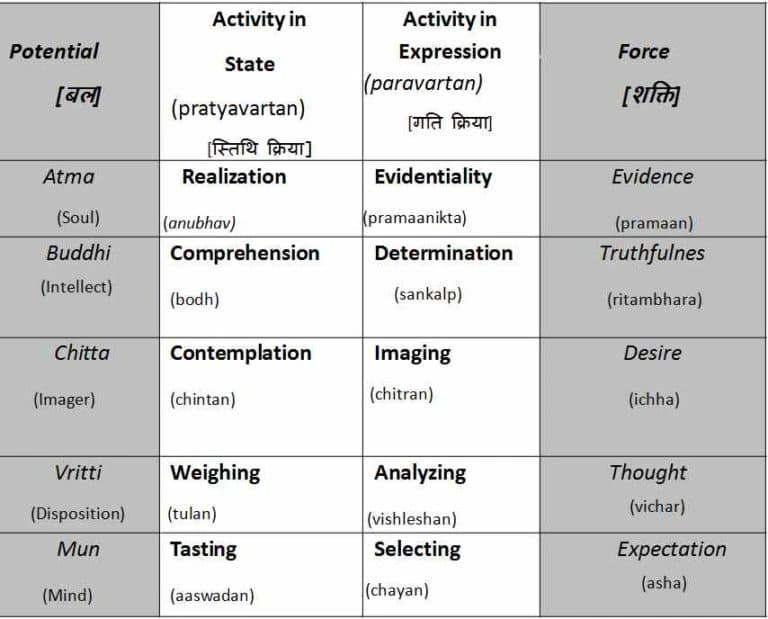
* English terms in the table are indicative and under revision. Refer to original Hindi nomenclature for accuracy.
- Atma (Soul):The central particle of jeevan, responsible for Realization (Experience) of Coexistence and Evidencing (Display) as ‘Evidence.’
- Buddhi (Intellect):The first orbit, handling Comprehension and Determination, expressed as ‘Truthfulness.’
- Chitta (Imager):The second orbit, managing Contemplation and Imaging, expressed as ‘Desiring.’
- Vritti (Disposition):The third orbit, performing Weighing and Analyzing based on perspectives like justice or profit, expressed as ‘Thought.’
- Mun (Mind):The fourth orbit, handling Tasting and Selecting, expressed as ‘Expectation.’
The conscious unit, saturated in space, embodies consciousness.
Jeevan’s activities include identity, tasting, thinking, desiring, and more, detailed in Madhyasth Darshan, all of which can be studied.
It is possible to fully know one’s conscious self.
Unawakened State: Living in Delusion
Only 4.5 of 10 activities are awakened, leaving 5.5 unknown, causing unresolved issues and problems.
In animal-consciousness, cognition is limited to form and properties, leading to incomplete assumptions.
Weighing is restricted to ‘likes, health, profit,’ causing unstable desires and contradictions, resulting in unhappiness.
Wrong assumptions about relationships manifest as numerous problems, limiting understanding of Existence or Reality.
Awakened State: Living in Human-Consciousness
Awakening all 10 activities results in resolution and happiness, encompassing knowledge of Self, Existence, and humane conduct.
Living with Law, Restraint, Balance in natural orders and Justice, Religion, Truth in human order.
Requires consciousness development to understand all four reality dimensions across natural orders.
Living with knowledge of Actuality, Reality, and Truth ensures harmony and happiness.
Imagination, now based on knowledge, provides surety, confidence, and happiness.
Truth is understood as Absolute, Relative, and Objective Truth.
122 Conducts in the Awakened Self
The conscious unit (jeevan) comprises 61 particles, each with state and motion, totaling 122 conducts.
- 64 activities in Mun (mind): 32 state, 32 expression.
- 36 activities in Vritti (disposition): 16 state, 16 expression.
- 16 activities in Chitta (imager): 8 state, 8 expression.
- 4 activities in Buddhi (intellect): 2 state, 2 expression.
- 2 activities in Atma (soul): 1 state, 1 expression.
Each activity is defined in Madhyasth Darshan.
Understanding increases from the fourth orbit to the center, with the center (atma) grasping complete reality concisely.
Understanding Jeevan Enables:
Knowledge of psychology, sociology, economics, spiritualism, humanism, education, conduct, norms, systems, culture, and universal human constitution, all rooted in jeevan.
In animal-consciousness, these are merely words and imaginations, deformed due to partial awakening.
Snapshot of 122 Conducts in Awakened Jeevan
* English terms are indicative. Refer to original Hindi literature for accuracy.
| Potential in Jeevan | Location in Jeevan Atom | Basic Activity | Corresponding Conducts (in Awakened Jeevan) |
|---|---|---|---|
| Atma | Centre | Property of indestructibility and active presence – (astitv – naash rahit gun) | In State: Realization (anubhav) Complete acceptance from existential progression. Conduct: Eternal presence as Nature saturated in Omnipotence (truth, satya). In Motion: Evidentiality (pramaanikta) Supreme Bliss (paramanand): Transparency of Atma, experience in pervasiveness. Conduct: Expression, Communication & Exposition of realization. In State: Comprehension (bodh) Comprehension of Truth, Reality, Actuality. Conducts:
|
| Buddhi | First Orbit | Comprehension of Truth (satya bodh) | In Motion: Determination (Sankalp) Allegiance, unwavering objective for evidencing Realization. Conducts:
|
| Chitta | Second Orbit | Form, Properties, Counting, Time, Expanse, Effort, Motion, Constitution (roop, gun, ganana, kaal, vistar, shram, gati, parinaam) | In State: Contemplation (chintan) Emergence & qualitative improvement via Desire. Conducts: Verbalization, Wisdom, Lustre, Scrutiny, Love, Satisfaction, Guidance, Reverence. In Motion: Imaging, chitran (Desire, ichha) Absorption and creation of images based on Contemplation. Conducts: Memory, Art, Form, Properties, Prosperity, Unanimity, Spontaneity, Veneration. |
| Vritti | Third Orbit | Decision based on likes, health, profit OR justice, religion, truth (priy, hit, laabh, nyaya, dharma, satya) | In State: Weighing (tulan) Based on likes-health-profit or justice-religion-truth. Conducts: Knowledge, Fame, Peace, Grace, Competency, Gratitude, Trust, Justice, Identity, Courage, Feelings, Race, Contentment. In Motion: Analyzing, tulan (Thought, vichaar) Decision and image expansion based on weighing perspectives. Conducts: Intelligence, Entities, Steadfastness, Compassion, Forgiveness, Politeness, Magnanimity, Sensitivity, Law, Thriving. |
| Mun | Fourth Orbit | Tasting & Selection via 5 senses in the body (sound, touch, form, flavor, smell). | In State: Tasting Based on preference, values, and goals. Conducts: Devotion, Care, Respect, Affection, Health, Enthusiasm, Acceptance, Preference, Happiness, Relations, Soft/Hard, Cold/Hot, Sweet, Sour, Spicy, Bitter, Pleasant/Unpleasant, Nice/Bad. In Motion: Selecting Decision based on taste in Tasting. Conducts: Engrossment, Generosity, Allegiance, Fondness, Responsibility, Duty, Progress, Perseverance, Nourishment, Inhale/Exhale, Welcome/Unwelcome. |
* Conducts are detailed in "Human Consciousness-Oriented Psychology" (manav sanchetana-vaadee manovigyaan).
Collected and translated by Shriram Narasimhan | Student | Jan 2015.
Go to top of the page