Educational Philosophy
The need for humane education
Despite the long history of education, outcomes for individuals, families, society, and the environment remain unsatisfactory due to the lack of universally defined humane education content and processes.
Every child expects justice, desires right behavior, and speaks truth but depends on education and tradition to understand these realities. Without a clear understanding, varied beliefs lead to confusion.
Summary of the need for human education:
- Humans live based on assumptions, beliefs, and understanding.
- Unlike animals, human behavior conforms to their values (sanskar).
- Changing beliefs alters behavior, goals, and actions.
- Humans have imagination and freedom of action, leading to diverse beliefs.
- Other entities in nature exhibit definite conduct; humans lack this.
- Humans innately desire right understanding and definite living.
- Realities like Justice, Religion, and Truth exist and can be understood.
- Education enables humans to use imagination to live rightfully.
- Education fosters definite human conduct, harmony, and coexistence.
Summary:
- Humans belong to the ‘knowledge-order’; knowledge is their fundamental need.
- Humans expect to understand truth about everything.
- Realities exist, and humans can understand them.
- Humans have the capability for such understanding.
- Education enables this understanding.
View of Reality/Worldview/Ontology
Our education is based on a deep understanding of human consciousness, mind, and psychology via Madhyasth Darshan philosophy, emphasizing coexistence and harmony in existence.
Humans are in an ‘awakening progression’ state, with partial understanding. As part of the ‘knowledge-order,’ happiness is achievable through knowledge and living with ‘human consciousness.’
Role/Objectives of Human Education
Education enables understanding of truth, fostering actions and conduct aligned with goodness.
It addresses unhappiness and conflict by enabling happiness, peace, and satisfaction through knowledge.
Education transforms individuals to live with resolution, prosperity, trust, and coexistence, addressing spiritual, intellectual, emotional, and material needs.
It fosters civility, culture, and societal roles, aligning with universal human goals.
Content of Education
Education includes knowledge, wisdom, and science covering conscious and material realities:
- Knowledge: Why and how things exist.
- Wisdom: Purpose and laws of living.
- Science: How to live and behave (values, material science, skills).
Covers physical, chemical, and conscious activities for mental, behavioral, social, and natural balance.
1. Self Education (Jeevan Vidya)
- Understanding self, activities, goals, happiness, and fears in reality.
2. Behavioral Education (Value Education)
- In Family: Understanding relationships and intrinsic values.
- Social Education: Recognizing human unity and social laws.
- Human Organizational Education: Learning societal roles and duties.
3. Material Education (Vastu Vidya)
- Skill-Based: Learning practical skills for livelihood.
- Material Science: Understanding physical-chemical processes.
- Ecological: Learning harmonious interaction with nature.
Multidisciplinary and Holistic Education
1) Life Themes
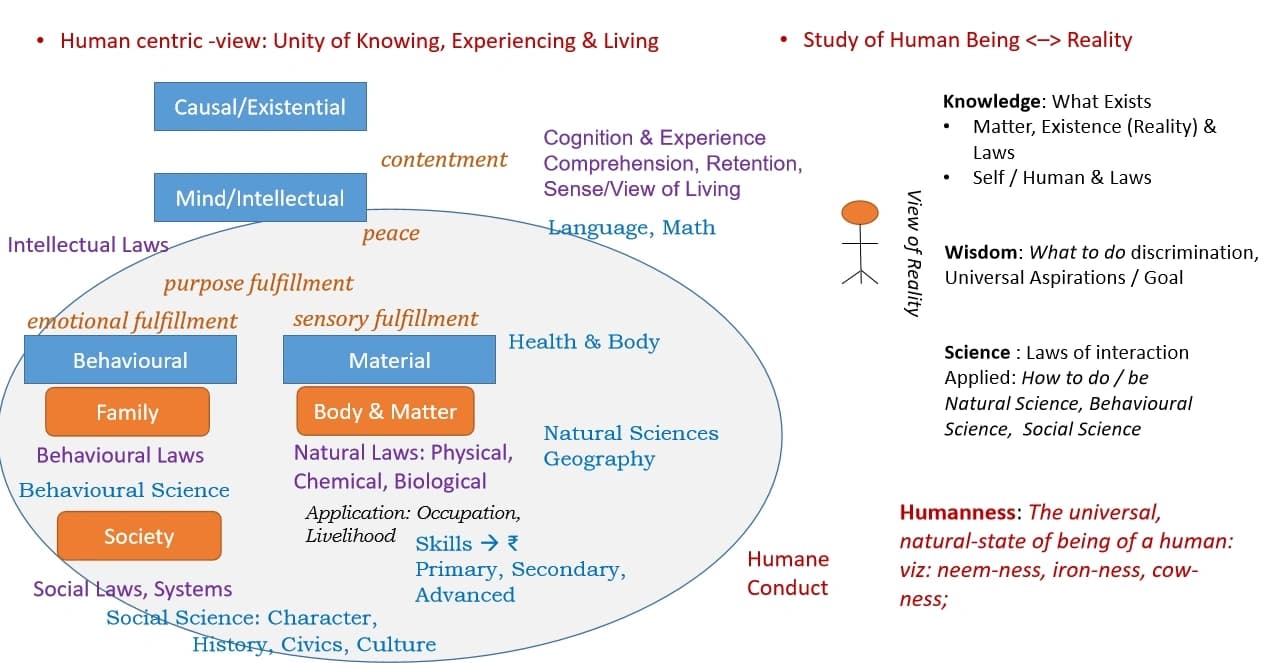
- Human-centric view with the student’s experience at the center.
- Based on understanding consciousness and brain function.
- Subjects relate to real human living, fostering curiosity.
- Connects theoretical knowledge with practical experience.
Reasoning:
- Human living spans four dimensions with specific fulfillments.
- Education provides understanding to meet these needs.
- Knowledge, Wisdom, and Science form the basis for inputs.
- Subjects are taught age-appropriately to complete understanding.
Address the 4 Dimensions of Human Living
Experiential/Existential
Fulfilled by: Purpose, Happiness, Fulfillment, Peace.
Intellectual/Rational
Fulfilled by: Language, Math, Logic, Reasoning.
Behavioral/Relationships
In Family: Trust, Affection, Care, Respect, Kindness.
In Society: Ethics, Social Character, History, Civics, Culture.
Material/Occupational
Fulfilled by: Natural Sciences, Geography, Skills.
The 5 Levels/Spheres of Living
- Individual
- Family
- Societal
- Nation
- Inter-Nation
Stages of Human Life
- Student life (vidyarthi)
- Householder – Relationships + Economic aspects (grahastha, arthik)
- Old Age
Fulfillment/Happiness in Living
- Sensory Fulfillment & Material Security
- Emotional Fulfillment (Relationships, Family)
- Purpose-based Fulfillment (Society)
- Inner Peace (Clarity in handling life situations)
- Contentment (Confidence in comprehensive vision)
Subjects are experienced from the child’s perspective, combining intellect, emotions, and real-life experience.
Curiosity and happiness are fulfilled through clear connections in teaching.
- Integration class to clarify concepts age-appropriately.
- Embedding holistic understanding in individual subjects.
2) Family Life, Human Character
Equip the child with clarity and sensitivity to live within the family.
As a Student
- Relationships with parents, siblings, friends, and elders.
- Explored through theory, observations, and discussions.
As an Adult
- Meaning and responsibilities of marital life, its sanctity.
Old Age
- Sensitivities of aging, importance of seva for elders.
Delivered age-appropriately.
3) Living in Society, Social Character
Equip adults with clarity on social inter-dependencies.
My Relationship with Society
- Shared human goals and needs across dimensions.
- Dependence on society for food, clothing, shelter, services.
- Highlighting cooperation through discussions and content.
Society’s Expectations
Social laws include restraint in:
- Mind: Kindness, avoiding trouble or harm.
- Body: Respecting family sanctity, chastity.
- Wealth: Avoiding theft, following righteous wealth.
Breaching these leads to distress; taught through examples (e.g., news items).
- Mind: Defamation, harassment, dowry cases.
- Body: Infidelity, harassment, murder cases.
- Wealth: Theft, corruption, financial fraud.
Develops ethics and morality for social harmony.
4) Daily Routine and Health
Covers human anatomy, physiology, and basics of staying healthy, addressing modern lifestyle issues.
Need to Be Healthy
- Daily routine for organ function, inspired by natural cycles.
- Importance of waking, eating, exercise, and sleep schedules.
- Seasonal body changes and dietary needs, using traditional examples.
- Home remedies for common ailments to avoid over-medication.
- Linking routine to holistic life cycles (relationships, work, seva).
Learning Theory
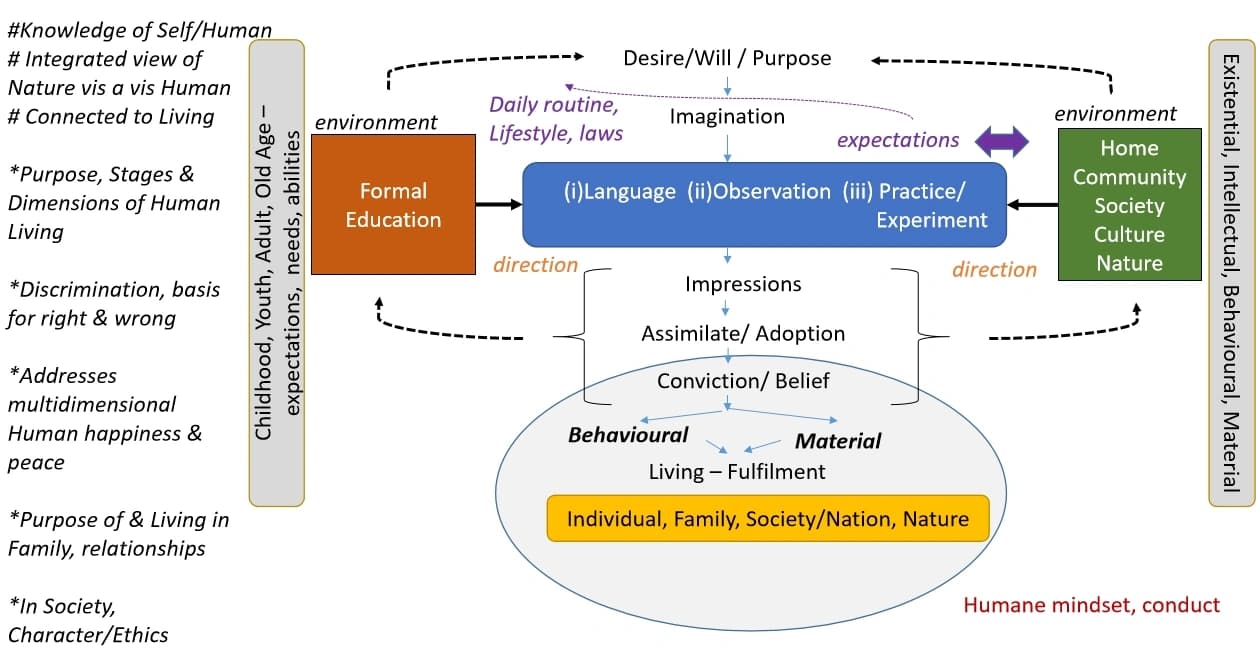
Environments as input sources for learning:
School: Formal content, teacher, peers, humane atmosphere.
Mutual expectations between school and child.
Outside: Home, community, society, culture, nature.
Mutual expectations with the child.
Child’s Mind and Learning
- Desire/purpose drives imagination.
- Imagination results from inputs.
- Inputs via language, experiments, observations.
- Child matches theory to observations.
- Observations form mental impressions (sanskar).
- Impressions shape convictions based on tendencies.
- Beliefs span individual, family, society, nature.
Develops a ‘human mindset’ defining identity.
Education fosters a comprehensive humane mindset.
Pedagogy/Process of Education
Transfers understanding from teacher to student using words to guide imagination.
1. Addresses the Self Directly
- Fosters inquisitiveness and exploration over rote learning.
- Respect: Encourages creative thinking and freedom.
- Critical Thinking: Enables evaluation of right and wrong.
2. Recognizes Human Relationship
- Based on teacher-student knowledge-sharing, not just a job.
- Values-based, avoiding fear or enticement.
- Promotes cooperation over competition.
- Encourages universal excellence.
3. Integrated Approach
- Subjects taught as interrelated, connecting cosmos to human roles.
- Addresses realization, thought, behavior, and occupation.
- Based on coexistence and harmony, not chaos or mysticism.
Outcomes of Education
Produces individuals with:
- Assurance: Trust in capabilities.
- Excellence: Recognition of others’ efforts.
- Balance: Living aligned with knowledge.
- Sociability: Ethical behavior in society.
- Self-Sufficiency: Skills for prosperity.
Supplementing Current Educational Content
Add missing aspects to complete education:
- Conscious aspect in Science.
- Mental-Impressions in Psychology.
- Ethical utilization in Economics.
- Humaneness in Sociology.
- Conservation of Humaneness in Political Science.
- Activity of Matter in Philosophy.
- Humaneness in History and Geography.
- Essential Reality in Literature.
Criterion for Evaluation & Acceptance
Human values education fulfills:
- Universal: Naturally acceptable.
- Perennial: Timeless truths.
- Logical & Verifiable: Appeals to reason.
- Livable: Enhances understanding and harmony.
Go to top of the page